
We make hundreds, if not thousands, of decisions every day. Most of them are small and inconsequential. Some are big and significant. Some of our decisions are good. Some bad.
Wouldn’t it be nice if more of them were good than bad?
And wouldn’t it be nice if we could improve our ability to make good decisions?
We can.
How can we make better decisions?
In this post, I want to offer: (1) questions to ask, (2) a framework to use, and (3) a few ideas on how to avoid or minimize common mistakes when making decisions.
NOTE #1: The questions, framework, and ideas below aren’t magic. They don’t guarantee good decisions. However, they are helpful. Some of us make decisions with very little thought. Having some questions and a framework can slow us down and help us think about our decision. Some of us can obsess over decisions and get stuck. Having some questions and a framework can help limit the amount of time we spend making decisions.
NOTE #2: This might be more important than the rest of the post. Seriously. We can get better, faster, at making good decisions if we aren’t afraid of making bad decisions. Mistakes are how we learn. Most bad decisions aren’t colossal mistakes. Failure isn’t final, it’s feedback. Don’t roll your eyes! It’s true! Make more decisions. Don’t be afraid. Learn from the bad ones so you can make better ones in the future.
On with the show…
QUESTIONS TO ASK
- What are you trying to decide? Are you clear on what you want? It is difficult to make a good decision when you aren’t clear on what you are deciding or what you want.
- How important is this? Are you spending an appropriate amount of time on the decision? Enough on important decisions and not too much on unimportant decisions?
- Is this decision easy to undo or not? Some have called these two-way doors (easy to undo) versus one-way doors (hard or impossible to undo). The harder a decision is to undo, the more careful you should be when making it.
- Can you make a smaller, temporary decision? Can you experiment or test out your decision? If possible, this is one way to shrink bigger, harder decisions.
- What and how much do you need to know before deciding? Do you have the information you need? Are you stalling by collecting unnecessary information?
- Who are you asking for counsel? Important decisions can benefit from getting counsel from trusted, experienced people. My dad told me, “A smart man learns from his mistakes. A wise man learns from the mistakes of others.” Learn from the experience of others. They are cheat codes for life!
- What are the known consequences of your decision options? Asked another way, “What is the price tag for this decision, and are you willing to pay it?” If the consequences are known, they are worth considering when making the decision.
FRAMEWORK
The following framework is from a Christian perspective, although you don’t need to be a Christian to benefit from it. I learned this framework many years ago from Greg Koukl of Stand To Reason and Garry Friesen’s book “Decision Making and the Will of God“.
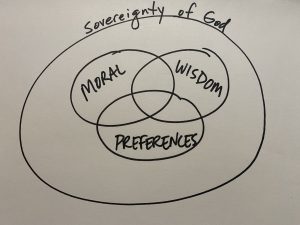
- Remember the sovereignty of God. You can’t mess up God’s plan. This isn’t a fatalistic, deterministic, “we are all robots” idea. Rather, I think God gives us a LOT of freedom. He works our free choices into his plans. If there are certain things he wants to happen, he will arrange circumstances so that they happen.
I say this because many Christians I have spoken to over the years worry about making bad decisions that will somehow ruin God’s plan for them. We don’t need to worry about that. God is in control. We can’t mess up his plan. Can we make life harder than it needs to be? Sure. Can we do things that will require correction? Of course. But we can’t mess up his plan. Don’t waste time worrying about this. Focus on making good decisions.
- Is there a MORAL component? Not all decisions have a moral component (Do I want the shirt in red or blue?). Some do (Should I become a teacher or a con man?). If they do, then eliminate any immoral options. You should only choose moral options.
- Is there a WISDOM component? Wisdom isn’t always black and white. Wise people can disagree on the best course of action, yet there is often a consensus. We can learn wisdom from our own experience and mistakes. We can also learn wisdom from others, both those we know and those we don’t (through books, for example). Sometimes we have struggled with these same decisions before. If not, others have struggled with them before us. If there is wisdom available for a decision we are facing, we would be foolish not to consider it.
- What are your PREFERENCES? If you have eliminated immoral and unwise options, then what remains are moral (or amoral), wise options. Which do you want? Which do you like? Your desires and preferences matter. There is nothing wrong with choosing an option simply because you like it.
- Are you praying about it? I believe that prayer matters because I believe there really is a God who cares about us. Praying is an act of humility. We can ask for help. We can ask for wisdom. We can ask for wise counselors to guide us. We can ask for clarity and courage to make good decisions. God will help us because God wants us to make good decisions, too!
COMMON MISTAKES AND HOW TO AVOID / MINIMIZE THEM
- Constraining Your Options. We often fixate on only one or two options. There are almost always more. Forcing yourself to come up with three, four, or more options will lead to better decisions.
- Confirmation Bias. We tend to seek or interpret evidence to support what we already believe or want. Being aware of it helps. Asking ourselves questions that challenge our preexisting views also helps. How could I be wrong? Why would an intelligent person disagree with me? What options would a person who disagrees with me suggest?
- Making Decisions When Overly Emotional. Our emotions are good things. They are often important signals to us. But we shouldn’t be controlled by our emotions, especially when making decisions. When dealing with strong emotions, slow down. Pause your decision-making process. Ask someone else what they would do. You can even imagine asking someone else what they would do. It is a helpful question because when we imagine someone else making the decision, they don’t have the same emotional baggage we do.
- Being Overconfident. How could this go wrong? What indicators can we establish to let us know when something is going wrong? If this were going to fail, what is the most likely reason it would fail?
REVIEW
This is often the most overlooked step. What happened? How did it go? How could you have done it differently? Are there any patterns you notice in your good or poor decisions?
Reviewing, evaluating, and learning from our own successes and failures in decision-making will help us make better decisions in the future. This requires honesty and accepting ownership. Blaming others or circumstances doesn’t help us learn.
Finally, let me re-emphasize the importance of not being afraid to make bad decisions (mistakes). Be courageous! We can do what we can to ask good questions, use a framework, avoid common mistakes, and review, but let us be bold in our decision-making! It will be OK. It really will. And we will learn. And we will get better.
Now go practice!
P.S. Did you find this post helpful? If so, I have two quick requests:
— First, would you subscribe to the blog? It is an encouragement to me.
— Second, who is one person you think would also benefit from this post? Would you mind forwarding it to them?
Thank you!
0 Comments