
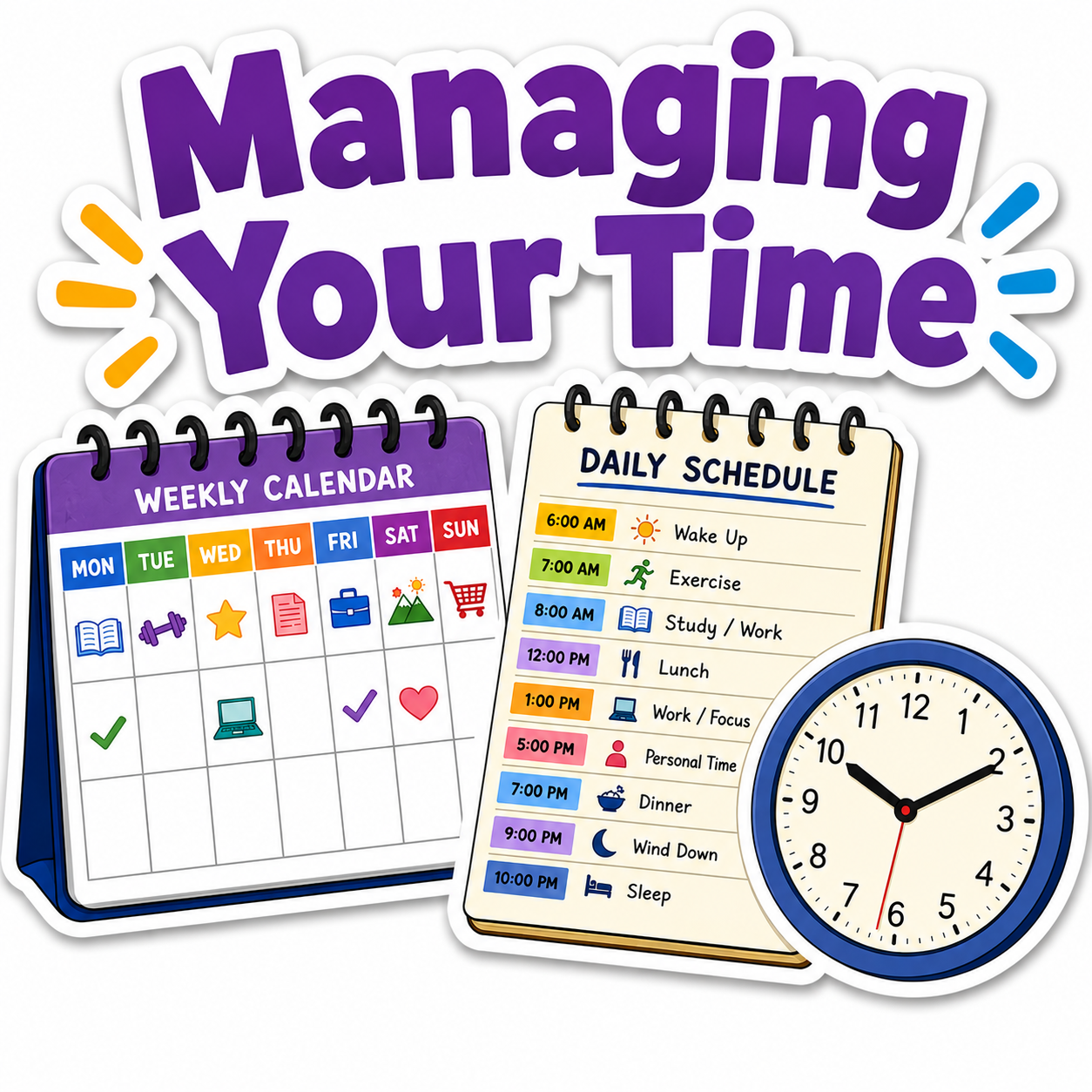
How we spend our days is how we spend our lives. Therefore, let us spend our days well.
Here are a handful of principles and techniques to help us do that.
Principles 1 & 2 – The Scarcity & Sufficiency of Time
It is a universal law that we will never have enough time to do everything.
It is also a universal law that we always have enough time to do the most important things.
Accepting these two statements as fundamental principles means that (1) we will have to make sacrifices and (2) we cannot blame anyone or anything else for not doing what is most important.
Principle 3 – Prioritization
This means that the most essential principle of time management is prioritization. We aren’t actually managing time, but managing our decisions on how we spend the time we have.
To prioritize well, we have to know what we want to do and what we need to do. We also need to be clear on how important each thing is to us.
Steven Covey’s Big Rocks illustration is the best I know for explaining this principle. It doesn’t mean that we will always do the big rocks before the smaller rocks, pebbles, sand, etc., but it does mean that we plan for them first. We plan in order of priority.
Principle 3.5 – Saying No
Related to prioritization: learn to say “No”. Most of us aren’t good at it. We must get good at it. Because of the constraints we all have, saying “Yes” to lesser things, even if they are good, means we are saying “No” to more important things.
Principle 4 – No Perfect Plan
There is no perfect plan. Repeat that after me: There is no perfect plan. Dwight D. Eisenhower famously said, “Plans are useless, but planning is indispensable.” This is an overstatement that makes the point clear. The plan will change because circumstances and variables will change, but planning is essential.
Accept that.
Those are the principles I would suggest are most helpful. I believe they apply to everyone. What follows are techniques that might work for some and not others. The key is to experiment and find what works for you.
Techniques
First, put it on your calendar. When we give our priorities a time block on our calendar, there is a greater chance we will do them. It is also a visual reminder that we have to make choices and trade-offs. That is a healthy and helpful reminder.
Even if we have to reschedule the activity, it is better to have it on our calendar than on a to-do list.
Second, a calendar without buffer time is fragile. It will eventually break. Usually at the worst possible time. Things are going to happen. They always do. Having buffer time built into our calendar makes it resilient. It provides us with flexibility. It is sustainable.
Third, plan time for joy, delight, rest, recovery, etc. This is a Big Rock on our calendar. It is time to “Sharpen the Saw”, as Covey would say. If we want to be good at managing our time, this is not optional.
Remember, things change. Circumstances change. We go through different seasons. Priorities change. This is an ever-moving and ever-changing target. There is no perfect. There is only good and helpful. Keep experimenting. Adjust as needed, keeping focused on what is most important to you and scheduling time to work on the most important things.
On a practical level, on my daily plan, I have one Highlight* at the top of the page and three MITs (Most Important Things). The highlight is what I am looking forward to most that day. It could be lunch with a friend, coffee with my wife, or some dedicated reading time. A couple of days each week, it is the time I spend writing these posts (“Biz Time”).
The three MITs are exactly what they sound like. The most important things I need to get done that day. There might be eight things I need to do, but I write down the three MITs.
If I can get the highlight and the three MITs done, it is a win for the day.
A Few Questions to Consider
I think the answers to the following questions will be specific to the individual, but are still important to consider if you want to manage your time well.
When are you at your best? This is an idea that Carey Nieuwhof makes in his book, “At Your Best“. We don’t have the same level of energy and attention throughout the day. When are you at your best (Green time, per Nieuhoff)? When are you dragging (Red time)? When are you somewhere between the two (Yellow time)? Don’t do your most important work during your Yellow or Red time zones. Do your most important work during your Green time zone. Plan your priorities with your energy and attention levels in mind.
What time blocks can you control? Control what you can control. Plan around the blocks of time that you can’t control. Put both on your calendar.
What things are affecting your ability to use your time well? Is it caring for little kids or a loved one? Is it your sleep? Your health? Your environment? What can you do to make sure that you are able to use your available time as well as possible?
I’ll end where I began. How we spend our days is how we spend our lives. That makes how we spend our days incredibly important and precious. The fact that we don’t know how many we have makes them even more precious.
Let’s get good at it.
* I got the idea of the highlight from the book “Make Time” by Jake Knapp and John Zeratsky, which is my favorite book on time management. I am not sure where I got the language for the MITs.
P.S. Did you find this post helpful? If so, I have two quick requests:
— First, would you subscribe to the blog? It is an encouragement to me.
— Second, who is one person you think would also benefit from this post? Would you mind forwarding it to them?
Thank you!
Just what I needed !!
I love getting these emails and Time Management (or as John Maxwell would say Mind Management) is one of my favorite topics! I so desire to be a good steward of the time the Lord has given me. Thanks for sharing and I will definitely pass it on.