In Building Habits #1 I discussed the Principles around building habits. If you haven’t read it, read it first. These are the most important ideas. There are probably many different ways to work out the mechanics. Different tactics will work for different people and the same people will might need different approaches at different times. Learn the principles.
With that said, there are very helpful tips about the mechanics of working out the principles that we can learn from others. That is what this post is about. Building Habits #3 will cover the Support Structure we can put in place to help us build the habits we want.
As I mentioned in the introduction to Build Habits #1, James Clear (Atomic Habits) and B.J. Fogg (Tiny Habits) come at this subject a bit differently but both have powerful contributions to make. I will give a summary overview of the process each one describes and then how I see they relate to one another. I will then provide some ideas on how we can implement these strategies in our lives to build habits.
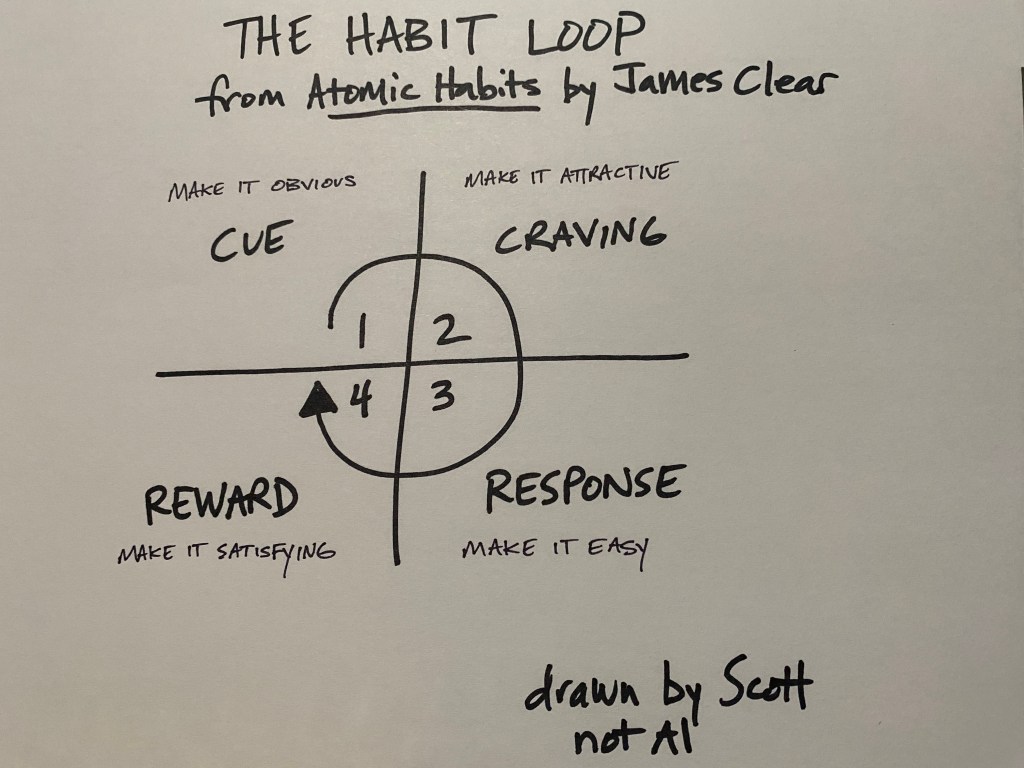
THE HABIT LOOP (ATOMIC HABITS)
A. Cue (Make it Obvious)
B. Craving (Make it Attractive)
C. Response (Make it Easy)
D. Reward (Make it Rewarding)
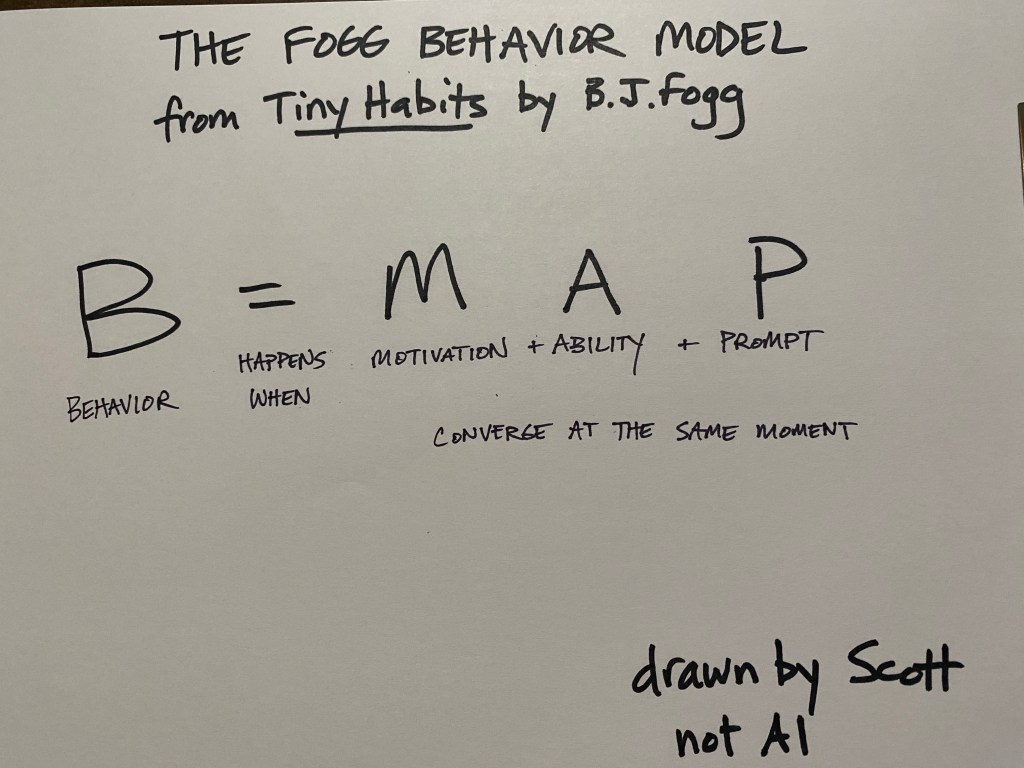
THE FOGG BEHAVIOR MODEL – TINY HABITS
B = MAP
Behavior happens when Motivation, Ability, and a Prompt converge at the same moment.
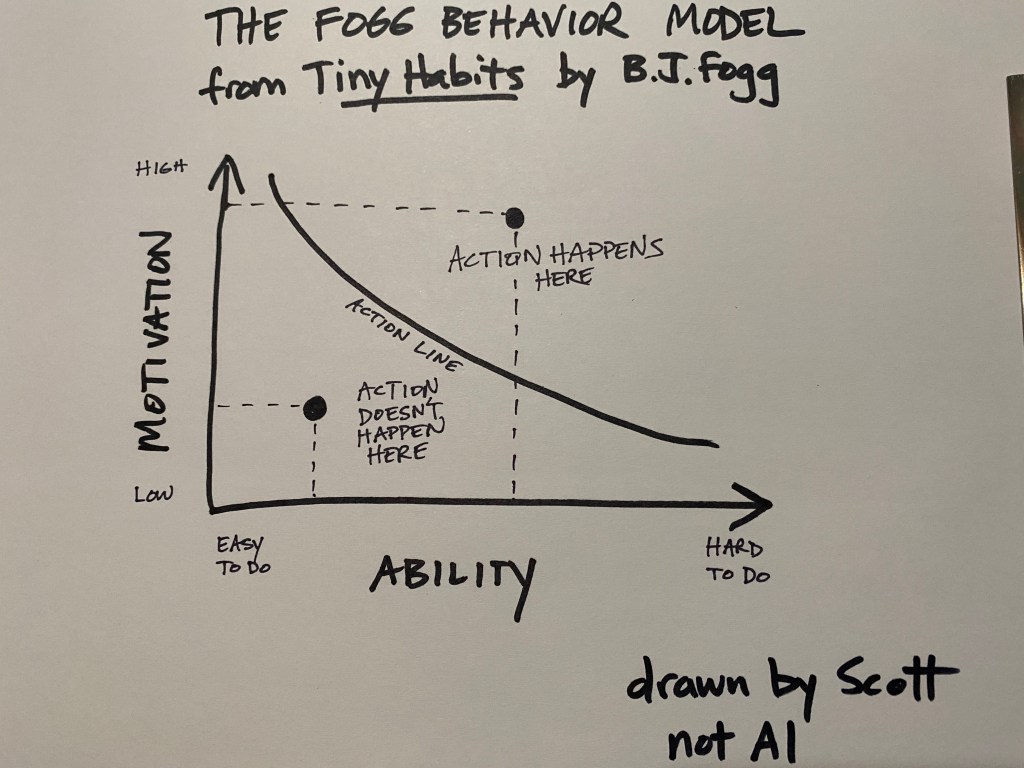
Although I won’t talk about it much directly, Fogg’s behavior graph is also helpful in thinking about building habits.
HOW THEY RELATE
Clear’s Cue aligns with Fogg’s Prompt.
Clear’s Response aligns with Boggs’s Ability.
To a lesser degree, Clear’s Craving and Reward align with Fogg’s Motivation.
HOW WE CAN USE THEIR IDEAS TO BUILD HABITS
Overall, I prefer James Clear’s Habit Loop model, so I will use that to organize and present my thoughts on the mechanics of building habits.
CUE / PROMPT – MAKE IT OBVIOUS
The first step in creating a habit is remembering to do it. This is the role of the cue or prompt. The main idea is to make it obvious.
Fogg talks about different types of prompts: personal, context, and action.
A Personal Prompt is something inside us that makes us do a behavior. Our memory. Our bodily urges.
A Context Prompt is something in the environment that reminds us to do a behavior. An alarm. A sticky note. The vacuum in the middle of the room.
An Action Prompt is when some action is the cue to do another behavior. Brushing our teeth. Taking a shower. Getting Dressed. Eating a meal. Getting in the car.
Action Prompts tend to work best and this overlaps with Clear’s idea of Habit Stacking. The best way to build a new habit is to connect it, anchor it, with a habit we are already doing. And there are tons of things we are already doing every day.
An important note: The cue should have same frequency and context as the desired habit. If we want to build a new habit of doing push-ups every day, you don’t want the cue to be going to the grocery story if you do that weekly and have no desire to drop down on the Walmart floor and do push-ups in front of everyone. A better cue might be brushing your teeth. “Every morning when I finish brushing my teeth I will do 10 push-ups.”
The question to ask: How can I make an obvious prompt that will remind me to do my habit?
CRAVING – MAKE IT ATTRACTIVE
The main idea with the second step of the habit loop is to make it attractive. It is more likely that we will do things we want to do and less likely that we will do things we don’t want to do.
In fact, this idea is so central to Fogg’s approach that he refers to it as Fogg Maxim #1: Help People Do What They Already Want to Do.
We should begin with building habits that we want to do, not habits that other people want to do.
We should also think in terms of specific behaviors and not general ideas or aspirations.
For example, rather than general aspiration of “Get in shape”, we should brainstorm as many behaviors as we can that would help us get in shape. From that list, we can choose a behavior we would want to do.
We shouldn’t say Running, Crossfit, or Brazilian Jiu Jitsu if we don’t like any of those things. Maybe you do like one of them. Great! But some us like yoga and others like jazzercise. The key is that it is something we would enjoy doing.
Start there first.
Sometimes, however, there are habits you want to build that you don’t think you are going to like. You just know you need to build it anyway. In these cases it can be helpful to reframe the habit and focus not on the activity itself but on the benefit that comes from doing it.
The question to ask: How can I make this attractive?
RESPONSE / ABILITY – MAKE IT EASY
This is one of the core principles. If we want to build a habit, make it easy.
I mentioned one of the ways to do this in the first post: The 2-Minute Rule. Clear explains,
“A new habit should not feel like a challenge. The actions that follow can be challenging, but the first two minutes should be easy. What you want is a “gateway habit” that naturally leads you down a more productive path.” (Atomic Habits, p. 163)
Fogg would go further and suggest making it a 30-second rule.
The examples I used were running and writing. The initial habit isn’t to run, but to put on our running shoes. The initial habit isn’t to write for an hour, but to write one sentence.
It isn’t because we only want to put on our shoes or write one sentence, but that we want to establish the habit so we can run or write and that means making it easy.
Will we sometimes only put on our running shoes and not run? Yes.
Will we sometimes only write one sentence? Yes.
AND THAT IS OK. That is the habit and we did it. It is another vote for our identity that we are the type of person who shows up and does our habit. It builds consistency and consistency is king.
The other wonderful thing about building consistency is that it makes the habit easier to do. With frequency comes ease. It is difficult to practice guitar at first, but it gets easier the more we do it.
In Clear’s quote he calls these initial habits, “gateway habits”. I love that. It reminds us that our ultimate goal is not to do easy things – in fact, maybe our goal is to eventually do hard things – but the more important thing, initially, is to establish the habit. That is why we want it to be ridiculously easy. The easy habit is the gateway habit to our bigger, harder habits later.
Fogg has “Three Approaches to Making a Behavior Easier to Do”. They are:
- Increase your skills
- Get tools and resources
- Make it tiny
We have covered the third approach, but the other two deserve comment.
We can make habits easier by increasing our skill in the habit or getting tools and resources. Maybe that means watching a YouTube video or getting some coaching from a friend. It could even mean taking a class or hiring an actual coach for a skill. My only caution is not to use increasing our skill as an excuse for not beginning our habit.
Watching a video or a quick meet-up with a friend? Sure, no problem. Taking a semester long class to learn a skill? Save that for later, after you have established the habit.
The same is true with tools. A new pair of running shoes or a journal? Go for it. A new, really expensive tool that we can’t afford? No. We can wait until we have proven to ourselves that we have built the habit while using less expensive tools. When we have earned it, perhaps the new, more expensive tool can be a reward (which is the final part of the habit loop).
Finally, although we want to put some thought into how we can make it easy, we don’t want to procrastinate to the point of paralysis. Sometimes the best course of action is: Just start! You can experiment and adjust along the way.
The question to ask: How do I make this easy?
REWARD – MAKE IT SATISFYING
“The first three laws of behavior change – make it obvious, make it attractive, make it easy – increase the odds that a behavior will be performed this time. The fourth law of behavior change – make it satisfying – increases the odds that a behavior will be repeated next time. It completes the habit loop.” (Atomic Habits, p. 186)
For Clear, this is how you lock it in and make it a habit. You make it satisfying.
For Fogg, this is the most essential element. Fogg Maxim #2: “Help people feel successful.” For Fogg, the whole enterprise boils down to helping people do what they want to do and helping them feel good when they do it. That is how you create habits. Everything else is details.
So, how do we do this? How do we make it feel good?
It is an immediate reward at the end of the behavior. Both Clear and Fogg stress the importance of immediacy. It can’t be 30 minutes later. The reward comes immediately at the end of the behavior.
It doesn’t have to be big. The reward can be simple and small. A big smile. A verbal exclamation, “I did it!” A high-five to a partner or even to yourself. To yourself? Yes. It actually works. Mel Robbins has a whole book about it: The High 5 Habit.
One of the small but effective ways that Clear suggests is Habit Tracking. It can be a calendar, a journal, a notecard, whatever. Clear has a free template you can download here. It is simply a way to record the fact that we did our habit that day. It is remarkably satisfying to me to check the boxes on my habit tracker card each day.
A caution about habit tracking: There is a positive pressure that comes from tracking habits to keep the streak alive. This is a good and helpful pressure. It helps build consistency. It helps build evidence that we can see that we are becoming the type of people we want to be. But all streaks come to an end at some point. Things come up. Life happens. When that happens, we need a plan for how to get back on track and not let it derail all of the work we have put in. I will discuss this in the next post concerning Support Structures.
Another way to make it satisfying, and a tie-back to making it attractive, is to make sure we are doing things that we enjoy doing. Doing something we enjoy doing solves this step of the habit loop from the beginning.
Finally, as we think about how to make our habits satisfying, it is important to align our rewards with the goal of our habits. A slice of chocolate cake is probably not a good reward for going on a run if the reason you are going on a run is to be healthy.
Ultimately, we are shaping our identity and we want our habits and the rewards for those habits to support that identity.
The question to ask: How can I make this habit immediately satisfying when I finish it?
FINAL COMMENTS ON THE MECHANICS OF BUILDING HABITS
I have reviewed several steps and ideas around the mechanics of building habits. For some, this might seem overwhelming. There can be a temptation or pressure to have to figure it all out and design a perfect habit system before you get started.
That is a recipe for failure.
Approach all of this as a series of experiments you are conducting.
You don’t have to commit to your new habit for a year. Commit to it for a week. Try it out for a day.
See what worked and what didn’t. What was helpful and what wasn’t.
Keep what worked and was helpful and discard the rest. Then try a new experiment for a day or a week.
You will get better at it and as you get better at it you can experiment with longer commitments.
In the end, building habits is a skill. You are not only building a specific habit but learning a meta-skill for how to build any habit. Getting good at the skill of building habits will have ripple effects. You will feel different. You will see yourself differently. You will become confident that you can change almost anything.
Because you can.
P.S. Did you find this blog post helpful? If so, I have two quick requests.
— First, would you subscribe to the blog? Each time I post something it will arrive in your email inbox. It is also an encouragement to me to see the number of subscribers grow.
— Second, who is one person you think would also benefit from this post? Would you mind forwarding it to them right now?
Thank you!
 scott stonehouse
Leave a comment